 EN
ENYaku-Ñawi: Artificial Intelligence for the Preliminary Detection of Microplastics in Water
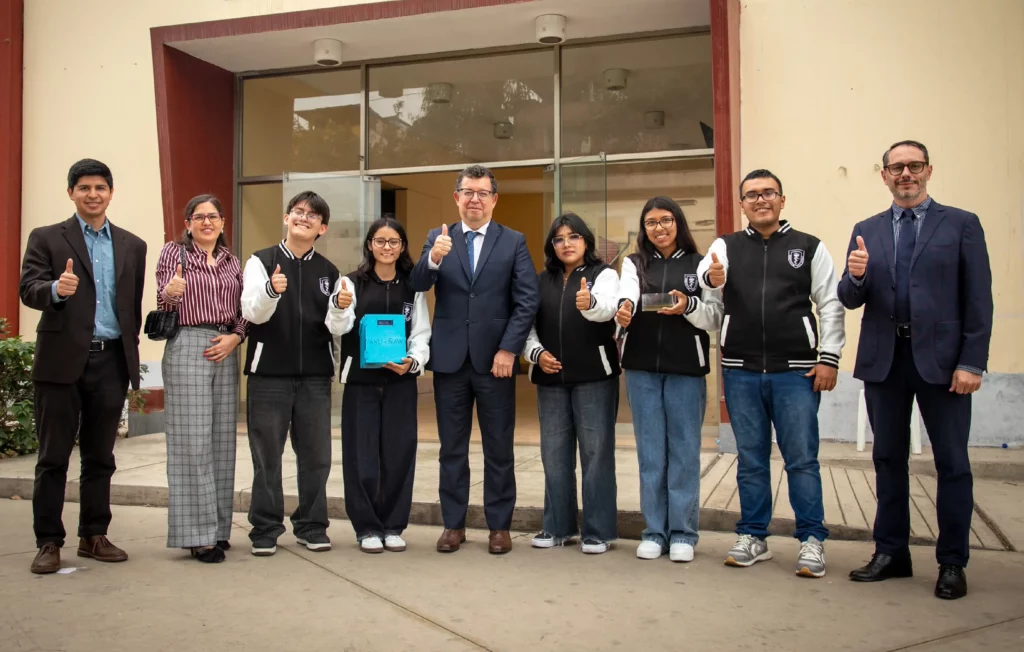
The portable device uses UV-A light, white light, a camera, and an artificial intelligence model to preliminarily identify PET and EPS particles in water samples.
An interdisciplinary team developed Yaku-Ñawi, a portable device that combines ultraviolet (UV-A) and white-light illumination, a camera, and an artificial intelligence model to preliminarily identify PET and EPS particles in water samples. PET is widely used in beverage containers, while EPS is commonly known as expanded polystyrene or Styrofoam.
The device works by illuminating water samples with UV-A and white light to highlight the characteristics of the particles. A camera then captures images, which are analyzed using an artificial intelligence model to preliminarily identify particles corresponding to PET or EPS.
The project aims to develop a portable tool capable of providing an initial detection of these types of particles and contributing to the monitoring of aquatic ecosystems. Its approach brings together knowledge from science, engineering, and artificial intelligence to address the environmental challenge posed by microplastics.
Yaku-Ñawi is being developed by students from Computer Engineering, Industrial Engineering, and Environmental Engineering, with the support of six faculty advisors from the Faculty of Sciences and Engineering.
The initiative is part of a broader regional effort to promote science communication. The Ibero-American Researchers’ Night (NII), an initiative promoted by the Organization of Ibero-American States for Education, Science and Culture (OEI), seeks to extend the objectives of the European Researchers’ Night to Ibero-America.
At Universidad Peruana Cayetano Heredia, promoting and raising the visibility of initiatives such as this helps highlight the value of science, engineering, and artificial intelligence in generating new ideas and solutions. Yaku-Ñawi demonstrates how the integration of different fields of knowledge can open new pathways toward tools and responses to contemporary environmental challenges.